NEW 48V Wall Battery from WattCycle (100Ah LiFePO4) – Worth It?
Troubleshooting note from this video
📝 Description
Take a first look at the new WattCycle 48V 100Ah wall-mounted LiFePO4 battery designed for off-grid and hybrid solar systems. In this video, we unbox, inspect, and break down the features, specs, and build quality of this battery to see how it compares to competitors like EG4.
https://www.wattcycle.com/products/48v-100ah-wall-mounted-5120wh-bluetooth-lifepo4-battery?ref=gzogaoop
6% Discount Code:KMG
This battery is designed as a cost-effective alternative to premium wall-mounted energy storage systems while still offering CAN/RS485 communication, expandable capacity, and built-in BMS protection.
What’s Covered in This Video:
Unboxing and included hardware (cables, brackets, fuse)
Mounting orientation and wall install design
Battery ports, terminals, and quick-connect system
Built-in screen overview and BMS data
Cell voltage balancing and pack status
Communication ports (CAN / RS485)
Parallel expansion capability (up to 15 units)
Key Highlights:
51.2V nominal (48V system compatible)
100Ah LiFePO4 battery chemistry
Built-in display + real-time data monitoring
125A breaker + full BMS protections
Expandable system design for solar setups
Who This Battery Is For:
Off-grid solar users
Hybrid inverter systems
Backup power setups
DIY energy storage builds
Coming Soon:
Full capacity test
Charging/discharging performance
Long-term review
Chapters below for quick navigation
0:00 Unboxing & Included Hardware
0:08 Cables & Accessories Overview
0:22 Mounting Brackets & Fuse
0:32 Battery Orientation Explained
0:55 What This Battery Is (Overview)
1:09 Model Number & Specs Intro
1:27 LiFePO4 Battery Explanation
1:35 Comparison to EG4 Batteries
1:42 Right Side Controls (Breaker + Power)
1:54 Voltage & Current Ratings
2:09 Overcurrent Protection Specs
2:22 Parallel Battery Capability
2:30 Terminal Connections & Quick Connects
2:55 Pros & Cons of Connectors
3:09 Communication Ports (CAN / RS485)
3:20 Address Settings & Parallel Setup
3:28 Rear Mounting System
3:43 Powering On the Battery
3:50 Display Overview & Pack Info
4:01 Voltage & SOC Readings
4:03 Cell Balancing Data
4:20 Cell Voltage Breakdown
4:27 Active Balancing Discussion
4:35 Alarm & Status Screen
4:41 BMS Settings & Communication Menu
4:51 Product Info & Firmware
5:02 Screen Quality & UI Review
5:11 Battery Percentage Indicator
5:28 Detailed BMS Metrics
5:45 Balancing Settings Explained
5:54 Wrap Up + Future Testing
#SolarBattery #LiFePO4 #OffGridSolar #48Vbattery #WattCycle #EnergyStorage #SolarDIY #BatteryReview #SolarSetup #BatterySystem
Model: 51.2V 100Ah
Chemistry: Lithium Iron Phosphate (LiFePO4)
Nominal Voltage: 51.2V
Capacity: 100Ah
Energy: ~5.12 kWh
Max Charge Current: 100A
Standard Charge Current: 20A
Max Discharge Current: 100A
Overcurrent Protection: 110A ±10A
Cycle Life: 4000+ cycles (typical LiFePO4)
System Features
Communication: CAN / RS485
Parallel Support: Up to 15 batteries
Built-in BMS: Yes
Display: Integrated LCD screen
Mounting: Wall-mounted brackets
Terminals: Dual positive & negative quick-connect
Operating Conditions
Charge Temp: 0°C to 55°C
Discharge Temp: 0°C to 55°C
Safety Features
Overcurrent protection
Voltage protection
Temperature protection
Cell balancing system
batterybmsprotectionsystemvoltagewallbalancingcommunicationbuiltcellcurrentmountedmountingoverviewparallel
🎬 Related Videos
📝 Video Transcript
Mounting hardware, cables. Quick connect cables. About a yay length Cat 5 cable, 1 m. Mounting brackets.
More mounting brackets. Mounting bracket. A fuse. Now, this is right side up.
The arrows on the other side are pointing up. This is right side up. But, if you take a look at it, the battery is This is the backside of the battery and the front side is face forward. This right here is a 48-V 100-A wall-mounted battery from WattCycle.
So, wall-mounted batteries are not new. 100-A wall-mounted batteries are not new, but this battery is here new from WattCycle and the model number is 50 51. 2 100 A. That's what they call the model number on this battery.
And as most uh wall-mounted batteries in this 48-V range for, you know, off-grid or, you know, server rack type uh systems or, you know, hybrid systems stuff like that, this is a lithium iron phosphate battery. And this battery is priced and designed to compete with the EG4 wall-mounted 100-A you know, battery. As you can see right here, this right here is the front, has a screen on it. We'll turn it on in a second.
As you can see on this side of the battery, which is the right side if you're looking at the front, on the right side there's a power button and a 125-A rated uh DC rated circuit breaker. On this, you can see except the nominal voltage 51. 2. It's got standard input current, which is 20 A, a max of 100 A overcurrent protection, which is plus or minus 10 A at 110 A.
The overcurrent protection at discharging is pretty much the same, 110 A plus or minus 10 A. Parallel capabilities, you can parallel up to 15 units. Communication RS485 and CAN. Recommended temperature for charging, you know, it's got 0 to 55° C and also same for discharging, pretty much the same thing.
So, front side, moving around to the left side of the battery, you can see right here, it's got two sets of positive and two sets of negative terminals with quick connects. So, these quick connects they come with one set of cables for each one. It's It's It's a pro and a con, right? Some people like them, some people don't.
If you have a lot of these connectors, people like them, but I think some people just like to see just lugs on them so they can just make their own cable and stuff like that cuz otherwise you're going to have to pretty much buy these connectors and these cables from WattCycle. Too many people may not like that. So, obviously reset switch, ADS, which is address management system, you can set your own address. Dry contacts, it's got all the RS485 CAN, RS232, 485 1, 485 2, and you're probably going to be able to use them for when you're setting up parallel communication or parallel batteries, right?
They can all communicate. Backside of the battery, mounting brackets will probably go there where you can mount it up. So, if you're wondering what this hole on the side is going to be so that you can wall-mount it. Once it's on there, it doesn't really come off.
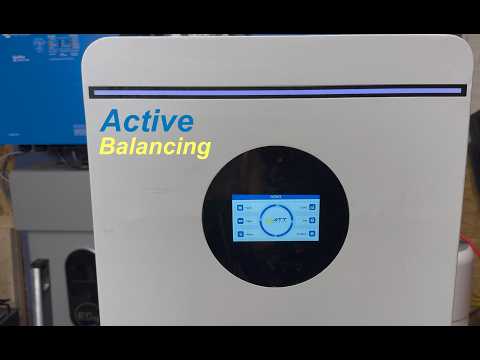
Makes it secure. So, let's go ahead here, move around to the front, and let's turn on the power switch and see what's on this screen here. So, taking a closer look at this screen here, it's got, you know, if you want to go here, home, it's got the pack information. Looks like it tells you right there, pack address one is at 61% state of charge.
I just pulled it out of the box. It's got voltage, all of this stuff going up in here. It's got cell information. It's got Looks like the cells are pretty well balanced according to the BMS that's in here.
They're right around 3. 286, 3. 287, 3. 286, .
86, . 86, . 85, . 86, 3.
285, . 84. So, 3. 284 may be the lowest one, and then you looks like there may be 3.
287. But, as you can see here, it looks like the numbers are changing. So, I'm wondering if there's an active balancer inside of here. We're going to have to go take a look at it and see what it says.
Alarm status, nothing going on there. Charge status, nothing going in. Said BMS communications and that kind of stuff here. We're not going to do that right now since this is just a preliminary look, but all that stuff is really in here.
Product information, the version numbers here. Serial number, if you care about that kind of stuff, that's going to be there. But, you know, it's a nice screen cuz it's colorful, got pretty good picture density, very responsive. And I'm not sure if you can see it here, but you can see on the top part right here.
I didn't notice this earlier. Is this blue bar This blue gradient. You see right here? It's a blue gradient.
And it looks like it's Since this is at 61%, I kind of wish there was a home button somewhere. Um 61% uh the pack, right? This bar looks like it's at 61%. I bet you if you charge it up all the way this will go to 100 and it's going to go down to pretty much close to zero.
So, take a look at that. Let's go take a closer look at this screen cuz there's stuff going up in here. Max voltage, temperature, current, balancing current zero. Current setting the balancing current, looks like you can balance up to 3 The opening voltage difference here is about 15 mV.
So, we're going to take a closer look at that and see if it's it's how it's balancing, but since this preliminary look, we're just going to take a quick look here. We're going to get this thing charged up, put it on a capacity test, and you're going to have to stay tuned for a full in-depth video on this battery.