Victron PowerAssist Demo | How the MultiPlus-II Combines Battery & Shore Power
Comparison that includes this video
🔗 Links Mentioned
Affiliate link — we may earn a commission if you purchase through this link, at no extra cost to you.
📝 Description
Affiliate link — we may earn a commission if you purchase through this link, at no extra cost to you.
Victron PowerAssist Demo – MultiPlus-II Real-World Test
Inverter: https://signaturesolar.com/victron-multiplus-ii-12-3000-12v-input-3000w-output-120-240v-120a-charger-transfer-switch?ref=bkpkbxde
Cables: https://www.batterycablesusa.com/anderson-sb-battery-cables
VIctron Smart Dongle: https://amzn.to/3RETr9C
10 AWG Ferrule for victron: https://amzn.to/4wSnjj3
In this video, we demonstrate one of the most useful features built into Victron MultiPlus-II inverter chargers: PowerAssist.
PowerAssist allows a Victron inverter charger to combine power from shore power, grid power, generator power, or other AC sources with energy from the battery bank. This allows you to power loads that exceed the available AC input without tripping breakers or overloading a generator.
For this demonstration, I use a Victron MultiPlus-II 12V 3000VA inverter charger connected through the VictronConnect app and VE.Bus Smart Dongle.
During the test:
• AC input current is intentionally limited to 9.3 amps
• AC loads require more power than the AC source can provide
• The MultiPlus-II automatically enters PowerAssist mode
• Additional power is supplied from the battery bank
• When the load decreases, the inverter automatically switches back into charging mode
This feature is extremely useful for:
• RV electrical systems
• Van life power systems
• Mobile power trailers
• Off-grid solar installations
• Backup power systems
• Generator-powered systems
• Shore power applications
• Marine electrical systems
PowerAssist is one of the biggest reasons many users choose Victron Energy products. It allows smaller shore power connections, household outlets, and generators to support larger loads by intelligently supplementing available power from the battery bank.
Equipment shown:
• Victron MultiPlus-II 12/3000 inverter charger
• Victron VE.Bus Smart Dongle
• VictronConnect App
• 12V battery system
If you're building a mobile power system, RV power setup, van conversion, boat electrical system, or off-grid backup system, PowerAssist is a feature worth understanding.
#victron #victronenergy #multiplus #multiplusii #rvlife #rvlife #offgrid #solarbattery #solarpower #vanlife #invertercharger #batterybackup
00:00 Victron PowerAssist Demo Introduction
00:18 Connecting Through VictronConnect
00:34 Setting AC Input Current Limit
00:58 Why Input Current Limits Matter
01:09 Victron PowerAssist Mode Explained
01:27 AC Input vs AC Output Power
01:47 Battery Power Makes Up the Difference
02:04 Why PowerAssist Is Useful
02:18 RV, Campground and Mobile Power Applications
02:43 Combining Shore Power and Battery Power
03:04 Automatic Transition Between Modes
03:22 Load Reduction Demonstration
03:30 Switching From Assist Mode to Charging Mode
03:52 Why PowerAssist Is So Valuable
04:14 Real-World Mobile Power Benefits
04:29 Final Thoughts
Model MultiPlus-II 12/3000/120-50
Battery Voltage 12V
Inverter Rating 3000VA
Continuous Output 2400W
Charger Current 120A
Transfer Switch 50A
PowerAssist Yes
PowerControl Yes
Communication VE.Bus
Bluetooth Requires VE.Bus Smart Dongle
App Support VictronConnect
AC Input Current Limiting Yes
UPS Functionality Yes
Battery Support LiFePO4, AGM, Lead Acid
Applications RV, Marine, Mobile Power, Off-Grid, Backup Power
powervictronpowerassistbatterymultiplusinputinverterchargercurrenthttpsmobilemodeshoresystemsbus
🎬 Related Videos
📝 Video Transcript
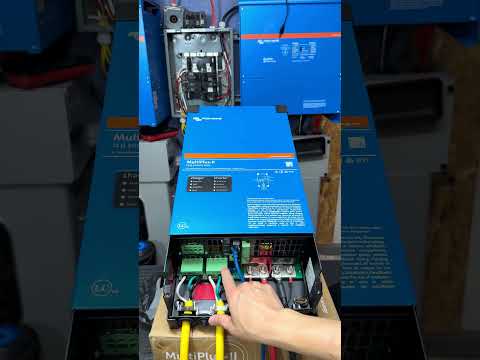
Hey what's going on guys, welcome back to the channel. On this episode, I'm going to show you a quick demo of the power assist function on the Victron MultiPlus II units or pretty much on most of the Victron units, they're all the same. So, without too much further ado, let's get to it. So, as you can see on the screen right here, we are connected using the Victron Connect app to the Victron Smart Dongle, which is in turn connected to this MultiPlus II unit.
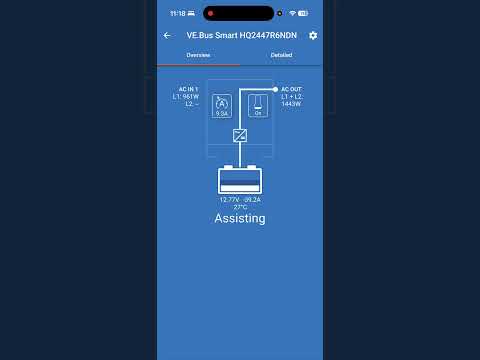
This is a MultiPlus II 12-V 3000 VA unit and as you can see on the screen right here, uh we've limited the AC current input to 9. 3 amps, which is the lowest it'll go on this configuration. Uh why did we do that? Mainly purpose for the demo.
Why would you do that in the future? If you were to connect this thing like your remote power system to you were to take it to somebody's house, you just have a small extension cord or you go to a campsite and you have a smaller outlet than let's just say a 50-A outlet, this is where you would configure that uh AC input because you don't want to tell the inverter that it can draw essentially all 30 amps or 50 amps when you're only connected to a smaller outlet, right? That's going to cause problems. So, as you can see right here on the overview screen, it tells you you are in assisting mode, aka power assist mode.
So, drilling down into it, you'll see the AC output or the AC output the inverter is pushing out is essentially 1400 W ish, right? It's going up and down. Um and then the AC input power coming in from the wall AC in one is about 967 W. So, roughly about 900-ish W is coming in from AC mains power.
So, the rest of that power you need, you know, let's just say roughly around uh I don't know, 400-500-ish uh W that's missing, it's got to come from somewhere, right? Uh that power is being drawn essentially from your battery. So, as you can see on the battery icon, this is a 12-V battery. It's pulling roughly 40-ish amps, 39-42 amps or whatever, from the battery to make up the amount of power it needs to support the load on the inverter.
So, why is this important and why is this cool, okay? It's important because if you were to install a mobile power system, you can essentially take it to any site that you need to take it to and adjust your AC input, right? As we were talking about earlier, you went somewhere and they didn't have 30-amp RV plugs or 50-amp or 30-amp plugs or whatever it was, right? But you wanted to power all your loads, let's just say AC fridge, TV, what whatever you need to power, right?
You can still power all your loads while pulling as much power from the AC mains power that you're connected to and pulling some from your battery. Sure, you won't be charging, right? Your batteries from that connection while you're in power assist mode, but if your if the AC is only on for, you know, let's say 30 minutes at a time or whatnot and then it's off for another 30 minutes or or whatnot, right? Or you just needed, you know, high high draw for a little bit of time, whenever you needed that high draw, it would pull from the battery and then whenever that high draw wasn't needed, it would then charge the battery, right?
That's exactly how that would work. So, let me go ahead and show you here. If I turn off one of the loads, right? So, I just unplugged one of the chargers it was connected to and as you can see or even actually hear, right?
It went from assisting mode to charging mode, right? None of the relays click, none of that lag, any of that stuff, right? Now, all not all, but the power that's coming in from AC mains is going to support the AC output load from the inverter and also charging the battery, right? So, how cool is that?
So, that's how power assist feature works. It's very useful in many cases. Uh I would definitely have something like a servo or a Bluetooth dongle connected so you can control that, especially if you're in a mobile power system. If you're in a permanent install, you probably don't need, you know, that kind of stuff.
But, uh mobile power system, this is going to be very crucial. Uh it's very important to, you know, adjust to exactly what you need, but, you know, the the ability to do that kind of, you know, opens pathways of where you can use these types of systems. And right now, because there's not enough load, the inverter charger is actually in charging mode, right? So, eventually, you know, uh when everything comes out, it'll just be only powering or pass-through power, but the battery's got a good bit of go to charge up.
So, hopefully this helped you guys out. If you have any questions, let us know. Otherwise, have a great day, get back to work, and we'll see you guys next time. >> [music]